
The 3-Second Rule: How to Find a Safe Following Distance
Updated: October 2026
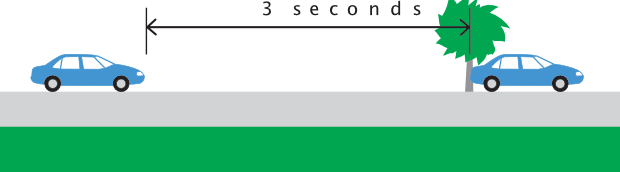
How to Use the 3-Second Rule
- Pick a fixed point ahead on the road — a sign, overpass, tree, or building.
- When the vehicle in front of you passes that point, start counting: "one one-thousand, two one-thousand, three one-thousand" (or "one-Mississippi, two-Mississippi...").
- If you reach the fixed point before finishing the count, you're following too closely.
Keeping at least three seconds of distance between you and the vehicle ahead gives you the time and space you need to react if something happens in the lane in front of you — regardless of how fast you're actually going.
When to Increase Your Following Distance
The 3-second rule is a baseline for good conditions — it should grow as conditions get worse:
- Heavy traffic, nighttime, or mild weather (light rain, light fog, light snow): double it to 6 seconds.
- Poor weather (heavy rain, heavy fog, heavy snow): triple it to 9 seconds.
Avoiding Tailgating
Following too closely is called tailgating, and it's an aggressive driving behavior that's easily mistaken for road rage. Most rear-end collisions happen because the trailing vehicle was following too closely to react in time. The 3-second rule is one of the simplest ways to avoid being that driver. And if someone is tailgating you, the safest response is to move to another lane or exit the road when it's safe to do so, letting them pass.
Don't worry about other drivers who think you're leaving too much space — it's your safety on the line. Following too closely can also result in a ticket, on top of the increased crash risk.
The 3-second rule is one piece of a bigger defensive driving toolkit — see our full guide to defensive driving strategies for more.
Frequently Asked Questions
Is it the 2-second rule or the 3-second rule?
You'll see both taught. Some driver's ed curricula use a 2-second minimum, but 3 seconds is the more common standard and the one used in the Texas driving safety course curriculum. When in doubt, use 3 seconds in good conditions and more as conditions worsen.
How many car lengths is a safe following distance?
It depends on your speed, which is exactly why the 3-second rule works better than counting car lengths. A fixed number of car lengths doesn't scale with speed, but counting seconds automatically gives you more physical distance the faster you're going.
Does the 3-second rule apply in a school zone or parking lot?
The underlying idea, always leaving enough space to stop safely, still applies everywhere. At very low speeds the 3-second count translates to just a few feet, so use your judgment and leave extra room around pedestrians, buses, and blind driveways.